Asian Woman Mystery Paintings on Row of History

Asia is the heart of the world culture and heritage from the begaining of the human civilization . Harapa , Mahenja-daro ,Alexandria, Mesopotamia are a few example of that claims.

Asian Modern Paintings Tries To Draw Attention of Life As How To Survive By Indian Women

Asian Modern Paintings Tries To Draw Attention of Life As How To Survive By Indian Women.

Artificial canvass creation in nature with amazing flashes of life by Asian Lady Webmaster

Nature has the deepest connection with human civilization.Asian lady webmaster has tried to remember the connection of artificial life

Asian Lady Webmaster tries the Mothers Love To Daughter with latest modern paintings of the year

It is natural beauty of the creator that all the mothers love their children but specially love daughter a little more.

Best selling paintings of Asian beauties with brain by Asian Lady webmaster

Modern Asian paintings are going right direct from 19th century before it was fully diversely with ancient form which were normally curved on stone , leaves or else where.Asian lady webmaster has tried her best

Showing posts sorted by date for query history. Sort by relevance Show all posts

Thursday, 28 March 2019

Modern and ancient Indian Contemporary Art: The Rise and Rise of the Style

What is extraordinary about contemporary art is the energy – it has our energy. New energy. Pieces hundreds of years old are beautiful from an aesthetic point of view, but without our modern energy. -Victor Pinchuk

The rise of Modern Indian Art dates back to the times when India was under the British Raj. A time had come when the craft and techniques were just on the verge of extinction. Traditional paintings by Indian artists were losing their significance and the artisans were struggling to incorporate innovation in their creations.
Pages from History:

It was during this period that noted painters like Raja Ravi Varma of Kerela and Abanindranath Tagore of Bengal had come to the forefront. The former sincerely attempted to earn a name by taking up mythological subjects as his area of interest. The latter, on the other hand, was struggling to establish a style of his own, revealing nationalism in his work. Inspired by his attempts, others soon followed, leading to the establishment of the Bengal School toward the beginning of the 20th century.

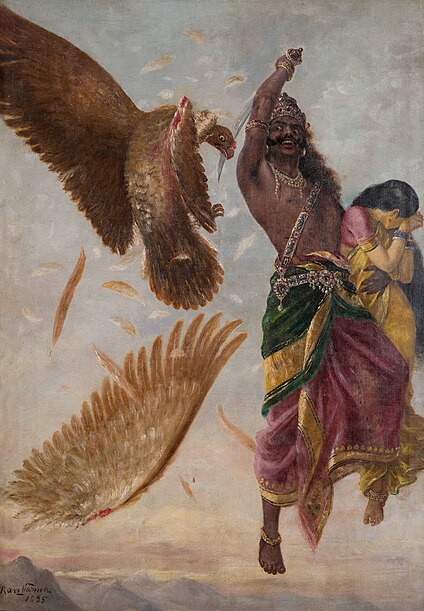
Ravi Varma Paiting of Ravana Sita Jathayu | Source: Wikipedia 


To say the word Romanticism is to say modern art – that is, intimacy, spirituality, colour, aspiration towards the infinite, expressed by every means available to the arts. – Charles Baudelaire.

Inspirations, of course, remained the same; subjects revolved around mythology and the classics. Eminent people like Jamini Roy and Rabindranath Tagore came up to give folk art a modern touch and introduced the concept of expression. A lot was experimented with colours and techniques. Chinese styles were welcomed and the lost craft of miniatures and frescoes was revived. This was the baby step of Indian contemporary art back then, which has only seen a mammoth growth in today’s world. Visit any art gallery in Kolkata, today. You’ll observe how their influences have not only remained strong, but also continued to inspire artists of modern times.


People always make the mistake of thinking art is created for them. But really, art is a private language for sophisticates to congratulate themselves on their superiority to the rest of the world. As my artist’s statement explains, my work is utterly incomprehensible and is therefore full of deep significance. – Bill Watterson


Later Developments of the Craft:

In the later years, artists like Amrita Shergill had successfully managed to merge the Western styles with Indian trends. She was the first lady to set foot in the world of modern Indian art and has set benchmarks for many. A large number of her works have been preserved by the National Gallery of Modern Art in New Delhi, and has been acknowledged by the Government as National Art Treasures. Indian contemporary original art of today, owes a lot to this lady.


The expanding canvas:


Modern paintings are like women, you’ll never enjoy them if you try to understand them. ― Freddie Mercury

Cross-over and mixing have become mainstream today. Foreign collaborations are common and the blend, in fact, is interesting, eye-catching. Amalgamation of culture is being encouraged more and more, fresh ideas are popping in, and the style is going global. The concept of surrealism has found its way into the style. Trends no longer bother artists; sharing of cultural differences and similarities does.


I feel like contemporary art is everywhere now and with the rise of the Internet, it’s so much easier to see what artists are doing and to follow their careers. – China Chow

Yes, the Internet is playing a huge role in promoting the popularity of the art form. You can now buy Indian art online. Galleries have hopped on from the physical world to the big web. Pick up any website that lets you buy Indian original art. The array that you perceive shall be wide and vibrant. Browse through sites like MyIndianArt.com. You’ll be received with a plethora of paintings and modern art designs that, each better than the other.


The strangeness will wear off and I think we will discover the deeper meanings in modern art. – Jackson Pollock

Sunday, 15 July 2018

Using deep and dark web links search engines for academic and painting scholarly research

You may have heard the term in passing before, the rumored-but-rarely-talked-about topic of the “deep web”. A web underneath the web, filled with petabytes of data and information that’s out of the reach of your standard Google, Bing, or Yahoo search bar. But what is the deep web exactly, and what purpose does it serve for the greater research community as a whole? 

Read the guide which was published on THE DARK WEB LINKS  to find out everything you need to know about the deep web, including what it means, where it lives, and how you can use it to your advantage.


The Deep Web: A Proper Definition

Google utilizes what’s known as a “spider-based crawler” to trawl the web for static webpage results, and then return them to you when you punch the right terms into the search bar. This only covers a very small portion of the actual information that’s available on the web.
Any results you get back from a basic Google search are from what’s known as the “Surface Web”. The Surface Web covers your basics: social media, news sites, shopping, blogs, etc.
Then there’s the Deep Web, which is not to be confused with the “Dark Web”, a portion of the internet most often associated with privacy protection connection services like TOR and online drug marketplaces like the now-defunct Silk Road.
The deep web contains a constantly updated torrent of raw, unchecked information, surging with complex technical terms and so many diagrams it’s enough to make Google’s Deep Dream AI blow a circuitboard. These are documents that keep records for things like census data, NASA mission data, patents, and academic paper databases.
It’s estimated that the whole of the entire surface web only amounts to about 20 terabytes of information, or 5 percent of the information available for open search. On the other hand, the deep web occupies about 7.5 petabytes of information, or just around 95 percent of the total.

How to Search the Deep Web

Knowing where to look when diving into the deep end of the web is the first, and probably most important step you should take before starting anything else. While the deep web is almost infinitely vast when it comes to the amount of information you can find, unlike what most people are used to when searching for something in Google, all of that data isn’t centralized in the same place.
This means for as many different subjects you can think of (finance, software, business, economics, academia, etc), there are an equal number of search engines designed to dive into the deep web archives of those particular subjects.
One issue that some researchers run into though is the problem of paywalls. There’s no getting around it; in order to run these websites/databases and keep the lights on, many of the sites mentioned below will keep their content hidden behind a paywall that can cost upwards of $50 to read a single document, or monthly subscription plans that get you access to all content for a flat fee.
If paywalls are a problem for you, one tool we recommend checking out is the Google Chrome browser extension Unpaywall. Unpaywall automatically scours the web for a free version of any content you’re trying to access that says it’s behind a paywall. You may not always get back a free result for every paper you search, however it’s still nice to the know the option is there if you need it in a pinch.
Below we’ve included a list of some of the services we think do the best job of cataloging all the information  you might need during your next research project, making special note to highlight those that make it easier to search through than most.
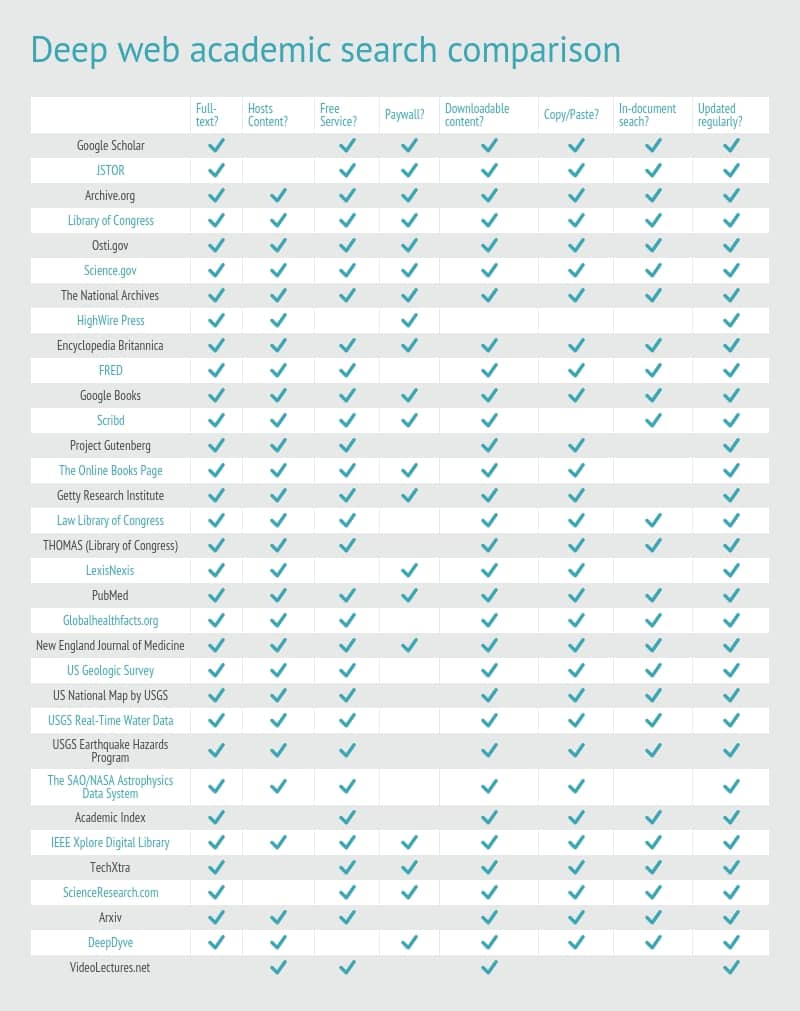
deep web academic search comparison

JSTOR – The first – and probably most obvious – addition to this list is the JSTOR database. Established in 1995, this treasure trove of research continues to be one of the first stops for any academic researcher on their way down the rabbit hole. Offering full-text searches for over 2,000 individual journals and 15,000+ books, JSTOR is a must-have for anyone who prefers a more “one-stop shop” approach during their data deep dives. JSTOR allows you access to up to three books for free, while a subscription to the JPASS service ($19.50 a month/$199 per year) will give you unlimited reading and 10 PDF downloads every 30 days (up to 120 per year). If you can’t afford that, many universities (more specifically, their professors) should have a subscription they’d be willing to let you use as long as you ask nicely enough!

Archive.org – A gigantic database of media that’s been entered into the public domain. Sound recordings, old videos, rare books, pretty much anything you might need to build your next great presentation at school, work, or both! Partnered with the Wayback Machine, which has over 280 billion webpages that have been indexed since nearly the inception of the internet itself.
Library of Congress – Digitized archives of everything that’s entered the Library of Congress. Over 200 years of historical information as well as up-to-date volumes
Osti.gov – Government research archives, complete with a history of all studies undertaken by the government. Your tax dollars paid for these, so why shouldn’t they belong to you? 100 percent searchable, and capable of returning results from within any document you’re trying to search for.

General

GPO’s Catalog of US Government Publications — Federal publications database.
The National Archives — National Archives’ research tools and online database. If there is anything you need to know about America’s history or the current state of the nation, this is the place.
HighWire Press —  Online catalog of the largest repository of free full-text and non-free text, peer-reviewed content, from over 1,000 different journals. It’s hit or miss as far as what’s behind a paywall and what isn’t. The only way to find out is to filter down your search terms to a point where you can see enough publications on both the paid and non-paid side of the aisle to decide whether or not you’ll need to pull out that wallet.
Encyclopedia Britannica – The original Google, now online with all the great pictures and text you still remember from the books!
FRED – Up-to-date financial data covering 470,000 time series from 85 different resources, this database is provided free of charge thanks to the helping hands over at the Federal Reserve Bank of St. Louis. FRED links out to a number of other equally impressive resources for economic data. It should be the primary resource for anyone doing research in the fields of finance and economic theory in the US.

Books

Google Books – The most obvious choice. Though the other listings below are fine for what they do, but none can quite measure up to Google’s book-scanning prowess. Some books will have partial previews, others fully available, and even more still won’t let you see anything at all. All text is digitized (and searchable), but whether or not you’ll be able to read your results depends entirely on the state of the copyright license on that particular piece of text.
Scribd – This may not exactly fill the role of your ultimate academic research database, however the monthly subscription service is still a good way to stay up to date on any new articles that might be running in your favorite magazines or be able to search through books that just hit the shelves. The documents section allows users to upload pretty much anything with few restrictions, so it’s become a repository for many textbooks and other academic content. 
Project Gutenberg — 53,000 free e-books available online, also part of the Archive.org searchable database.
The Online Books Page — A searchable database of more than 28,000 English books with the complete text available online.
Getty Research Institute – The Getty Research Institute library collections include over one million books, study photographs, periodicals and auction catalogs. There’s also a pretty deep collection of rare or unique materials that focus on art history and architecture.

Law and Politics

Law Library of Congress — Claims to be the largest collection of legal materials in the world, over 2 million volumes available.
THOMAS (Library of Congress) — Legislative information from the Library of Congress. All current and past bills that have ever been presented on the floor of the House of Representatives are archived here.
LexisNexis – Solid resource for any aspiring law student or practicing lawyer. Daily updated database of information, though it doesn’t come cheap. Prices for different services offered by LexisNexis will vary depending on the service and even what state you’re searching in, but expect to spend upwards of $125/month for services like Lexis Advance, which let you search through millions of court and legal documents submitted in actual cases from all around the United States. Your local library or university might have a subscription you can use.

Medical and Health

Science.gov — Gateway to science info provided by US government agencies. Searches an aggregated database of 200 million different publications and journals, best for anyone trying to do research on topics that are covered specifically under the “science” category.
PubMed  — The U.S. National Library of Medicine contains over 16 million citations from MEDLINE and other life science journals reaching all the way back to the 1950’s. One of the first, and still one of the best medical databases available online today.
Globalhealthfacts.org – Indexed database of world health information, searchable by disease type, country, conditions, symptoms, and more. Great resource complete with hundreds of infographics that can be used to explain the statistics of certain health problems on a broader scale.
New England Journal of Medicine – One of the leading medical journals with full text past issues available online. Be ready to pay for some content, but quite a bit is available for free as well.

Science and Academic

Geography and Geology


US Geologic Survey – Packed with as many maps and images as you can stomach, covering many different aspects of the the US geological topography.

US National Map by USGS – The source for current geospatial data from the USGS. All maps provided are both interactively available on the web, as well as in their downloadable formats.
USGS Real-Time Water Data — A map of the United States showing realtime water quality data of the country’s rivers and reservoirs.


USGS Earthquake Hazards Program — Maps of the world showing realtime earthquake data. Uses an interactive map that you can use to jump from location to location, fun for anyone who’s even got a passing level of interest in what’s really happening just under our feet.

Physics and Astronomy

The SAO/NASA Astrophysics Data System – A physics and astronomy data engine for academic papers. Every paper you want to read must be individually requested, which can be a hassle, but still one of the best ways to get your hands on the raw data pouring out from telescopes and physics experiments from all around the globe.
Academic Index – Splits into two different types of searches: the main search which basically returns more fine-tuned Google results, and the other that searches deep web academic troves.

Engineering and Technology

IEEE Xplore Digital Library – Contains over 1.4 million documents from the Institute of Electronics and Electrical Engineers. Searchable database of up-to-date materials regarding almost anything and everything to do with electrical engineering and technology as a whole.
TechXtra — Free access to reports, e-materials, research, industry news, and even job listings in the math, science, and engineering fields.


Misc


Core — The world’s largest searchable database of open access research papers. Huge database of aggregated papers and research, all text-searchable. Should be your first stop for any early research that may not require as deep of a dive as somewhere else.


Arxiv – Cornell University repository. Access to 700,000+  technical papers on everything from quantitative biology to computer science. Appears to offer full text in several formats.


DeepDyve – DeepDyve is a commercial trawler that has aggregated quite literally millions of articles across thousands of scientific journals. If you’re searching for anything in the way of STEM projects, this is a great place to start (you’ll have to pay for the privilege, however).


Video Resources 


VideoLectures.net – Really strong set of video lectures from high authority sources, nearly 20,000 lectures to choose from and over 22,000 informational videos in total.

Thursday, 9 November 2017

Modern Art: Vogue presents A to Z about the MET exhibition 2018

The Metropolitan Museum of Art’s upcoming spring exhibition, without a doubt one of the most anticipated of 2018, has just unveiled its theme: 


‘Heavenly Bodies: Fashion and the Catholic Imagination’, or the relationship between fashion and the Catholic religion. From Balenciaga to Dolce & Gabbana and Valentino, the exhibition will explore the history of fashion through Christianity’s dogmas and codes, an infinite source of inspiration for designers past and present.
 
Défilé Dolce & Gabbana automne-hiver 2013/2014

 
©The Metropolitan Museum of Art/Katerina Jebbof

© Metropolitan Museum of Art

Religion has always inspired designers. After last year’s Rei Kawakubo and Comme des Garçons’, theme, the Metropolitan Museum of Art is turning to Christian imagery in fashion for its spring 2018 exhibition, supported by Christine and Stephen A. Schwarzmann, Versace and Condé Nast, and named Heavenly Bodies: Fashion and the Catholic Imagination. From delicate, byzantine-inspired Chanel and Dolce & Gabbana dresses, the haute couture Garden of Eden à la Valentino and Balenciaga’s reinterpretation of a cardinal’s cloak, Christian imagery, history and symbols, given their place in the collection imagination, constantly inspire designers who don’t hesitate to draw on the Testaments for their collections.

 
© Metropolitan Museum of Art
 
©The Metropolitan Museum of Art/Katerina Jebbof

Metropolitan Museum of Art

 
Défilé Valentino haute couture printemps-été 2014

 
Valentino S.p.A MET/Katerina Jebb

The Costume Institute, the MET’s extensive fashion department, is set to display over 150 pieces playing on the powerful link between Catholicism and fashion this spring. Dresses, coats, jewelry pieces and accessories straight from the wardrobe of a Christian princess will be exhibited across three large spaces from May 10 to October 8, 2018. In an exceptional gesture, the Vatican will be lending the exhibition around 50 pieces, some of which come from the Sistine Chapel, including Papal robes, jewelry pieces, tiaras and other ecclesiastical treasures dating from the 18th Century to the present day.


As the theme of the MET’s fashion exhibition also dictates the theme of its prestigious annual gala, guests of the party will have to inspire their dress with Christian imagery. Who out of Rihanna, Amal Clooney and Donatella Versace, the evening’s hosts, will make the biggest impression on the red carpet? Find out May 7, 2018.

Gift of Mr. and Mrs. Edwin L. Weisl, Jr., 1994 (1994.516) Image © Metropolitan Museum of Art

 
Gift of J. Pierpoint Morgan, 1917© MET

The Metropolitan Museum of Art/Katerina Jebb Heavenly Bodies: Fashion and the Catholic Imagination, May 10 to October 8, 2018, Metropolitan Museum of Art, 1000 5th Ave, New York, NY 10028, USA

Monday, 4 May 2015

Best Modern Indian Paintings re-canvassed in 2015

It is said that the great Indian painting creation strategies was started before starting the Hindu civilization. The Indian paintings have a very long tradition and history in Indian art and culture. The earliest Indian paintings were the rock paintings of pre-historic times as those are seen in various caves as well as stone writings, the petroglyphs as found in places like Bhimbetka where some of them from before 5500 Before Christ. East India Company paintings were made for British clients under the British raj in modern India, which from the 19th century also introduced art schools along Western lines or directly can say British tradition comes to Indian paintings. As it is leading to modern Indian paintings, which is increasingly returning to its Indian routes of arts and culture. The Rajput painting, The Mysore painting, The Tanjore painting, The Madhubani painting, The Pattachitra, The Mughal paintings are very famous in india. I have brushed some most famous Indian paintings once again without violating original owners' copyright.

Best Modern Indian Paintings re-canvassed in 2015

Just enjoy my re creation and comment if you like my collection works. 


Indian Paintings


Indian Paintings


Indian Paintings


Indian Paintings


Indian Paintings


Indian Paintings


Indian Paintings


Indian Paintings


Tuesday, 25 November 2014

Charles West Cope and contemporary paintings of Victorian era

Charles West Cope RA (Leeds 28 July 1811 – 21 August 1890 Bournemouth) was an English Victorian era painter of genre and history scenes, and an etcher. He was responsible for painting several frescos in the House of Lords in London.Cope was born at Park Square in Leeds, the son of Charles Cope, a watercolour landscape painter and art teacher. He was given the name 'West' after that of a celebrated painter, Benjamin West, and his only sister Ellen, given the middle-name 'Turner', after J M W Turner – both painters being friends of his father. His mother was "a gifted amateur" artist in watercolours who died shortly after Charles' birth.

Charles West Cope and contemporary paintings of Victorian era 

Charles was sent as a child to a boarding school in Camberwell, London, and afterwards to "Terry's school" (sic) at Great Marlow, where he was bullied and his elbow broken, which left him with a crooked arm for life. He then went to Leeds Grammar School, where he suffered from the attentions of a cruel teacher.In 1827, Cope's father was killed in a stage coach accident. That same year he entered Sass's Academy[1] in Bloomsbury, London, and in 1828 became a student of the Royal Academy. He obtained a silver medal from the Society of Arts in 1829, a second medal in the Royal Academy Life School, and a life studentship. About 1830 he lived at lodgings in Great Russell Street, Bloomsbury close to the British Museum.

In 1832 Cope went to Paris and practiced his art by copying Old Masters at the Louvre such as Titian, Rembrandt and others. In 1833 he exhibited at the Royal Academy for the first time – a picture called 'The Golden Age'. In September of the same year he travelled to Italy, where he spent two years – earning a living for part of the time by painting pictures on commission. His painting 'The Firstborn' was completed in Florence and exhibited at the British Institution.


Breakfast Time – Morning Games


The Village Schoolmaster


George Herbert And His Mother


News From Sebastopol


Convalescent

Best Painting of Stephen Gjertson in American Style

Stephen Gjertson was born in Minneapolis, Minnesota in 1949, the eldest son of Arthur and Betty Gjertson. Gjertson’s family loved to read, so it’s not surprising that his first exposure to the visual arts came from books. “We owned a set of encyclopedias that reproduced many works of art. We also had novels illustrated by artists such as N. C. Wyeth, Norman Rockwell, Howard Pyle and Dean Cornwell. I remember reading those books and copying the illustrations. Later, my interest in the Old West led me to history books and stories with paintings by Frederic Remington, Charles Schreyvogel and Nicholas Eggenhofer, whose pictures I also copied. For birthdays I received books on the great masters. The work of Michelangelo, Titian and Rembrandt made a lasting impression on me. That, I said to myself, is what I want to do.”

Best Painting of Stephen Gjertson in American Style 

Gjertson’s love for nature was born in the fields, woods and cliffs along the Kettle River in Sandstone, Minnesota, the home of his parents and grandparents. He filled his sketchbooks with drawings of trees, rocks and the ruins of old buildings scattered throughout the overgrown quarry and the surrounding countryside. He decided to make art his profession while drawing Pilgrims at Thanksgiving in the third grade. At age 10, he received his first box of oil paints for Christmas. His art teachers in both junior and senior high school encouraged the young Gjertson. After graduating, he attended the University of Minnesota, where he played drums in the Football Marching Band. The art department at the university was hostile to what he wanted to do as an artist, and instructors told him to not pursue the outmoded principles of traditional art. Discouraged, he left and attended art school for one year. There, he encountered the same senseless fascination with negative, theory-centric art and learned nothing of practical value. In 1971 he met Richard Lack and studied art seriously until 1975 at Atelier Lack, a studio-school based upon the teaching of the 19th century French ateliers and the Boston impressionists. In 1978 he met Kirk Richards, who was studying at Atelier Lack.


Stephen Gjertson and Kirk Richards have been close friends since they met in 1978. They were both trained by Richard Lack at Atelier Lack in Minneapolis, Minnesota, Gjertson from 1971-75 and Richards from 1976-80. The two have been painting and exhibiting together for twenty-five years, beginning with the seminal Classical Realism: The Other Twentieth Century, a large, traveling exhibition held at the Springville Museum of Art, The Amarillo Art Center and The Maryhill Museum of Art in 1982-83. They were members of The American Society of Classical Realism Guild of Artists and were part of Beauty: A Rebirth of Relevance, a four-person exhibition held at the Newington-Cropsey Gallery of Art in 1996. In 2003 they co-wrote For Glory and For Beauty: Practical Perspectives on Christianity and the Visual Arts. In 2003 they had a successful two-person exhibition, For Glory and For Beauty, at the Biblical Arts Center in Dallas.
In 2004 Richards suggested to Gjertson the possibility of finding another artist with whom they could exhibit.
Bedtime Story
After The Bath
The Recorder Lesson
The Newborn
Sleeping Beauty
The Miracle
Asleep At Last

Alexei Alexeivich Harlamoff tries to focus Russian Women's lives via paintings

Alexei Alexeievich Harlamoff who is also known as Alexej Charlamoff (1840–1925)[1] was a Russian painter.Harlamoff paintings are signed "Harlamoff", which may be a translation he learned while studying in Paris. This does not translate into the Russian language from English. One transliteration into English would be "Aleksei Alekseevich Kharlamov".

Alexei Alexeivich Harlamoff tries to focus Russian Women's lives via paintings

Alexei Harlamoff was born into a family of serfs on 18 October in the village of Dyachevka near Saratov on the river Volga. In 1850 Harlamoff’s parents win their freedom. Harlamoff becomes a guest student in 1854 at the Imperial Academy of Arts in St. Petersburg. Three years later he was awarded a second class silver medal for a drawing. In 1862 Harlamoff was awarded a second class silver medal for a sketch, and he is enrolled with the history painter Alexei T. Markov.


A Russian Beauty

The Pink Bonnet

Sisters

Spring Flowers

Little Girl

Mignon

Little Girl With Head-Dress

Faraway Thoughts

Flower Girl

The Flower Seller

The Red Bonnet

Young Girl In A Green Tunic

Young Girl Before A Blue Background

Girl

Head Of A Girl

Friends

Mother And Daughter

Unsatisfied girl 

The Flower Girls

The Little Seamstress

Little Seamstress